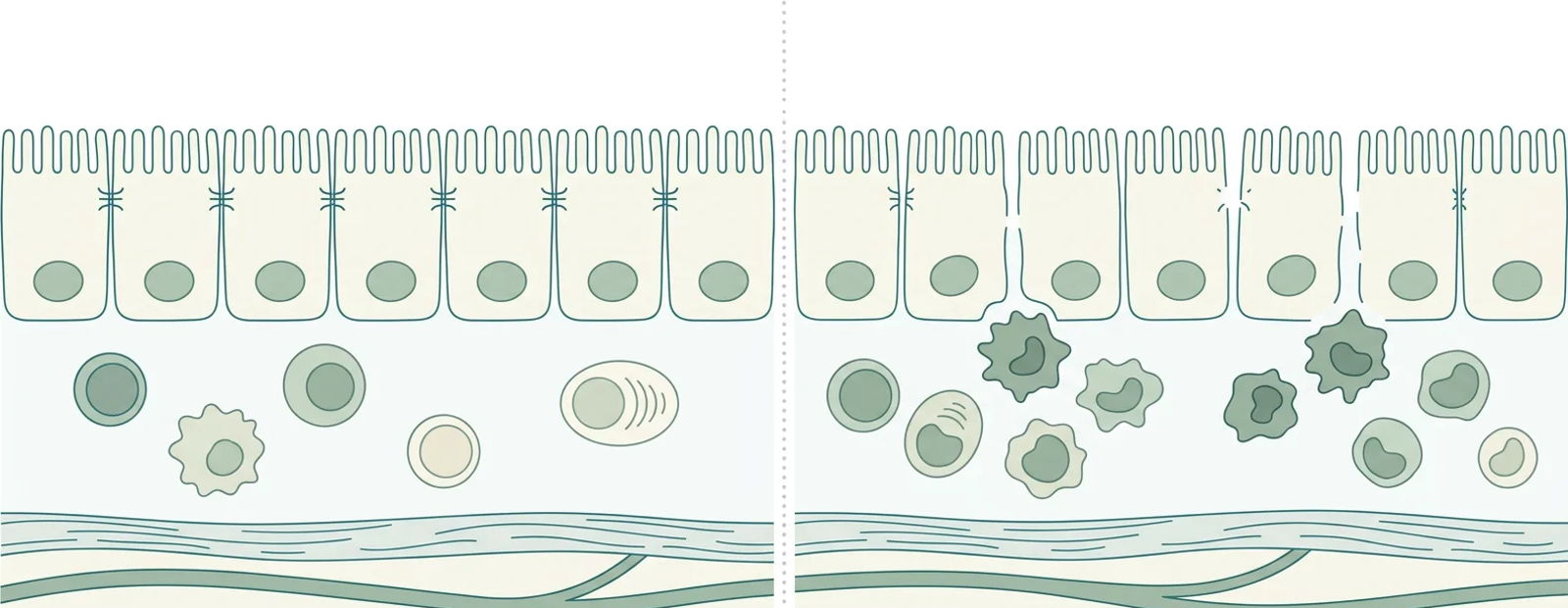
You have had clear skin your whole life. Maybe the occasional breakout, but nothing crazy. Then somewhere in your early 40s something changed. Suddenly you have rosacea on your cheeks, or hives that won't respond to anything, or eczema you haven't seen since you were a kid. And nobody can give you a good explanation for why.
And the answer you keep getting is some version of: this is just what happens as you get older.
It isn't. Or at least, that explanation is so incomplete it's barely worth calling an answer.
Your system that was holding things together
Here's a more useful way to think about it. Your body has been managing a load for years (gut inflammation, nutritional gaps, environmental toxins, stress, etc.) and for a long time, it had enough reserves to compensate. You didn't really notice any major symptoms and your skin was pretty clear. Everything looked fine.
Then your hormones shifted, and your reserves ran out.
Estrogen and progesterone don't just regulate your cycle. They are deeply involved in maintaining the integrity of your gut lining. Estrogen in particular helps keep tight junctions (the microscopic gatekeepers that control what passes through your gut wall and into your bloodstream) functioning properly. When estrogen drops in perimenopause, those tight junctions start to open up. The gut becomes more permeable. Things that were being kept out start getting through.
The immune system responds to that as a threat and inflammation increases. And the skin, which had been keeping up before, gets tipped over the edge.
This is not just getting older. This is a system that lost a critical support structure, and started showing the load it had been carrying all along.
What dropping progesterone adds to the picture
Progesterone has its own role in keeping inflammation in check. It calms down the immune system in ways that tend to get overlooked when the conversation focuses only on estrogen. As progesterone falls in perimenopause, which it does earlier and more dramatically than estrogen for most women, immune reactivity increases.
Progesterone also acts as a natural antihistamine so when levels drop histamine intolerance becomes more common. This lowers the threshold for a flare-up so things you used to tolerate before are now a problem.
My patients who suddenly can't tolerate wine, or certain foods, or their usual skincare products, often think that they've developed new allergies. Sometimes that's true, but more often, their immune system's tolerance has simply decreased because the hormonal buffer that was modulating it is gone.
The harm in dismissing this
For decades, women were told that hormone replacement therapy was dangerous. That message came largely from a misreading of one major study (the Women's Health Initiative, or WHI) and that has caused genuine, lasting harm. Generations of women were left to manage the inflammatory consequences of hormonal decline with no support, while the medical system handed them steroid creams and antihistamines and called it treatment.
The conversation around HRT has shifted significantly, and for many women in perimenopause it is worth an honest, individualized conversation with a physician who understands the current evidence. It is not the right answer for everyone. But the blanket fear around it meant that countless women suffered unnecessarily, and many still are.
This is where functional medicine fills the gap
Whether or not HRT is appropriate for you, the gut permeability and nutritional depletion that accelerate during perimenopause can be addressed. A stool test can show what's happening in the gut. A nutritional panel can identify the specific depletions, zinc, magnesium, B vitamins, vitamin D, that affect both skin barrier function and immune regulation. A personalized protocol can start rebuilding what the hormonal shift destabilized.
The goal is not to pretend the hormonal change isn't happening. It is to stop treating the skin like the problem, and start addressing the internal environment that perimenopause exposed.
Your skin didn't just decide to fall apart at 40. It finally ran out of room to compensate.
That distinction matters, because one of those has no solution, and the other one does.
If you want to understand what's actually driving your skin flares, not just manage them, I'd love to talk. A free consultation call is a good place to start. The link is at the top of the page. Or join my email list at the bottom of the page for straightforward, science-grounded information on the gut-skin connection and what functional medicine testing can actually show you.